

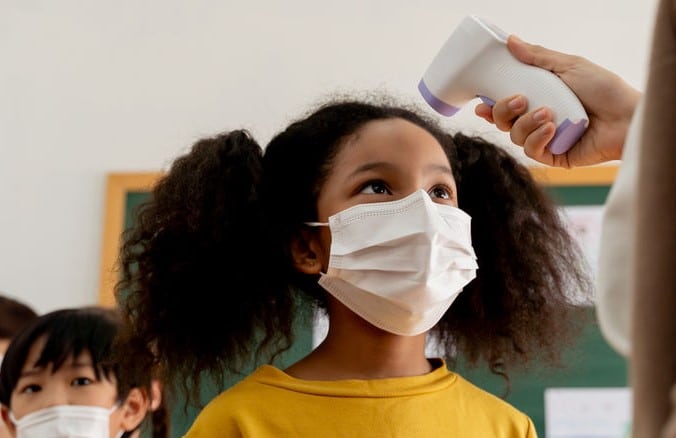
Although some schools have been open in person for months, some larger districts are just beginning to welcome students back on campus. Children, families, educators, and medical professionals have mixed feelings.
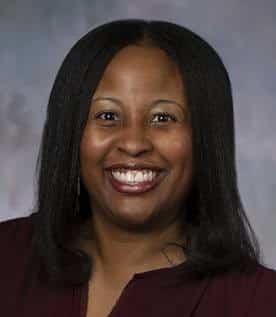
To help you support different patient populations as they return to school, we talked to Jennifer Walton, MD, MPH, a co-author of a call for an “URGENT Coordinated Effort to Re-Open Schools” by the National Medical Association (NMA). Dr. Walton is chair of the NMA’s Pediatric Section, an assistant professor of clinical pediatrics at The Ohio State University, and a developmental behavioral pediatrician at Nationwide Children’s Hospital.
“Clearly going back to school can be a double-edged sword,” said Dr. Walton. “Some families hesitate because of the risk of contracting COVID-19, as they may have household members with pre-existing conditions. At the same time, some families come from under-resourced situations where caregivers are working multiple jobs and finding childcare is difficult — so they really need to send their children back to school.”
Back-to-school is also a mixed bag for children with disabilities and other special needs. Dr. Walton said, “For example, some of our children who have autism spectrum disorder really had a hard time when schools closed because it disrupted their routine. But then again, many of these children have trouble with social interactions and social communication, so some of them were fine with online schooling! And now they don’t necessarily want to go back.”
Asked how pediatric primary care providers (PCPs) can help with this double-edged sword, Dr. Walton had one main piece of advice: Invest time to listen and communicate with patients and their caregivers. “Making time for honest conversations may be the most important thing you can do for families and children.”
“Every family is going to need to have that conversation,” Dr. Walton said. “I might not do anything different clinically — I just give parents and children the space to say what they’re afraid of, what’s on their minds.”
Acknowledging that PCPs often can devote only 10 or 15 minutes for an office visit, Dr. Walton suggests looking at whether other clinic staff can become involved and sit down with a caregiver or a child to continue the conversation. Building and sustaining trust with families is very important, now more than ever — and building trust takes time.
Dr. Walton offered suggestions for dealing with specific populations.
“There’s the COVID-19 pandemic, and then there are other pandemics,” she noted. The effects of racism and discrimination both on the disparate effects of the pandemic and on children’s mental and physical health are well documented. Dr. Walton and other NMA leaders recently published an article in Contemporary Pediatrics on talking to children about racism — a task that is particularly important as families and children who are Black, indigenous, and people of color (BIPOC) struggle with whether or not to go back to school.
“I am in favor of getting children back in school,” she noted. “The issue is whether all schools have equitable access to resources to support them in this process. When there is a positive COVID-19 exposure, what mechanisms are in place to make sure everyone is safe as that exposure is addressed?”
“Before the pandemic, inequities in schools existed for decades — and specifically in schools that teach children who are BIPOC. Our question is, how do we make sure it doesn’t get worse?”
For PCPs, dealing with patients’ experiences of racism in and out of school starts with “becoming more comfortable with having those conversations,” said Dr. Walton. “How are we as providers acknowledging that racism — from institutionalized racism to internalized racism — still exists and affects everyone?”
The history of racism and bias in healthcare, including pediatrics, is well documented. This history has led to mistrust, particularly for BIPOC families. “If this mistrust and its roots are not acknowledged, it will be difficult to have these conversations on racism and going back to school during the COVID-19 pandemic. It will be difficult to build and sustain trust,” Dr. Walton said.
Dr. Walton offers this advice to families of her patients with developmental differences, but it applies to every family: “You are the number one advocate for your child.”
“Parents and caregivers know the circumstances they are in,” she went on to say. “We as providers must collaborate with them and encourage them to take time and weigh the pros and cons before making a decision.” In decisions about whether or not to go back to school in person, PCPs can use the trust families have placed in them to empower caregivers to make the best decisions for their children.
RESOURCES
For PCPs
- Walton J, Freeman BK, Tyler-Hill Y, Brooks O, Smitherman L. Racism in pediatric health: How to talk to children about racism. Contemp Peds. 2021 Feb 10; 38 (2)
- Caring for Children in a Disaster from the CDC
For families
- COVID family resources from children’s hospitals, such as this family resource page from Nationwide Children’s Hospital or its Behavioral Health Resources for Coronavirus at OnOurSleeves.org
- Healthychildren.org COVID resources, specifically this page on going back to school
For everyone
- Embracerace.org, which has a variety of resources for children, families, and professionals


