

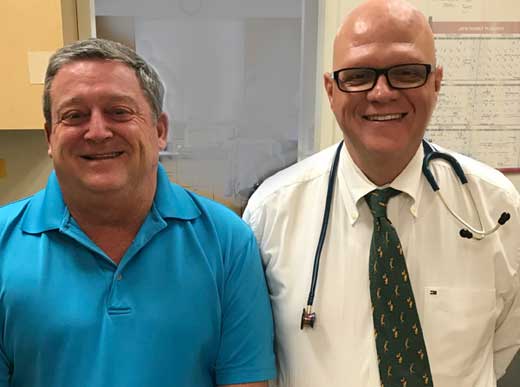
In the absence of a single child and adolescent psychiatrist anywhere in Cape May County, New Jersey, The REACH Institute training enabled Rainbow Pediatrics to help families who had nowhere else to turn.
“It has increased our volume,” said Thomas Dierkes, DO, FAAP. “But the big benefit is that we’re all on the same page, all using the same screening tools and the same methods to treat children with mental health issues.”
Rainbow Pediatrics, which has three locations in southern New Jersey, has sent every one of its clinicians to The REACH Institute’s three-day Patient-Centered Mental Health in Pediatric Primary Care (PPP) training. Among the many tools PPP graduates take back to their practices is a set of screening tools for common pediatric emotional disorders, from ADHD and depression to anxiety and oppositional defiant disorder. “I use at least one of those screening tools every day,” said Kirby Tompkins, RNP.
Another valuable tool the physicians at Rainbow use regularly is one-page guides on medications for common psychiatric disorders. “These tools may be common sense, but we can’t do without them in a fast-paced pediatric practice. These tools to assess, diagnose, evaluate treatment modalities–they enable us to initiate with speed but also with a deliberateness and confidence that would otherwise have taken years to develop,” noted Tompkins.
To Dierkes, another big advantage is that PPP standardized the practice’s approach to emotional issues. He pointed out that treating psychiatric illness is largely a matter of trial and error. After participating in REACH training, he said, “We’re all on the same page about what to try first and what are the next steps.”
“Getting everyone trained took a while, because we all had to travel to different locations,” Dierkes said. “But it was definitely worth the time and expense.”
He described the satisfaction of being able to treat, for example, a child whose anxiety keeps him from being able to go to school. “Now we can screen them, easily treat with FDA-approved medications, and monitor so that the child doesn’t have to stay on medication long term. The important thing is that now this child can go to school.”
PPP also helps clinicians to find treatment options beyond medication. For example, physicians learn to build a team of professionals who offer such treatment options as cognitive behavioral therapy. They also learn strategies they can teach to children and parents themselves. Tompkins, who had previously run a clinic for children and adolescents with emotional disorders, appreciated knowing that “there was good data behind the recommendations and decisions.”
Even more, he said, he appreciated what he called “the nuances of the REACH experience,” which he summed up this way:
“How do you approach a little human being who is a hot mess?”
Tompkins noted that, especially in dealing with emotional and behavioral issues, it’s important to establish trust. “You can’t just say, ‘I understand.’ You have to show that you understand. You say to the parent, ‘I can’t imagine how you’re dealing with all this. Tell me more.’”
Patient-Centered Mental Health in Pediatric Primary Care uses interactive teaching methods to demonstrate ways to establish trust. Trainers and participants role-play common scenarios of the issues parents and children bring in. “There was some hilarity!” said Tompkins of the training he attended in 2016. “We all recognized the ways these parents presented their child’s problems.” But the value lay in the opportunity for the participating clinicians to practice listening and showing compassion–and then to see how formerly frantic, angry, or disengaged “parents” reacted in ways that would make them better able to participate in their child’s healing.
Asked to sum up how his practice has benefited from REACH training, Dierkes said,
“We’ve had tremendous success. We now have a legitimate way to find the right treatment that works for children with psychiatric issues.”
Has your practice benefited from The REACH Institute’s PPP training? If so, please share this page with a colleague who could also benefit.


